
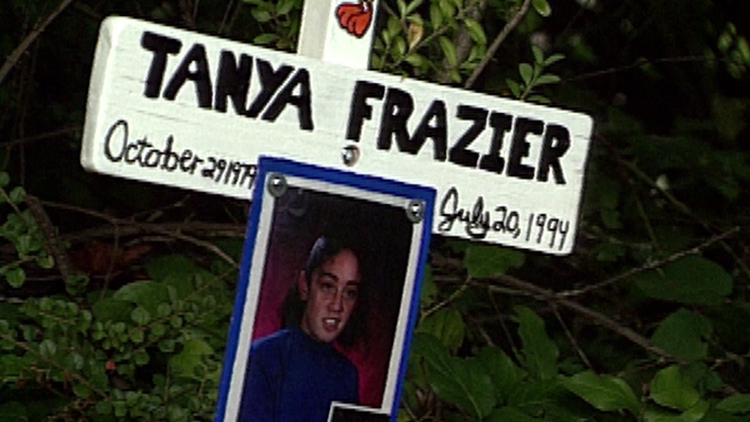
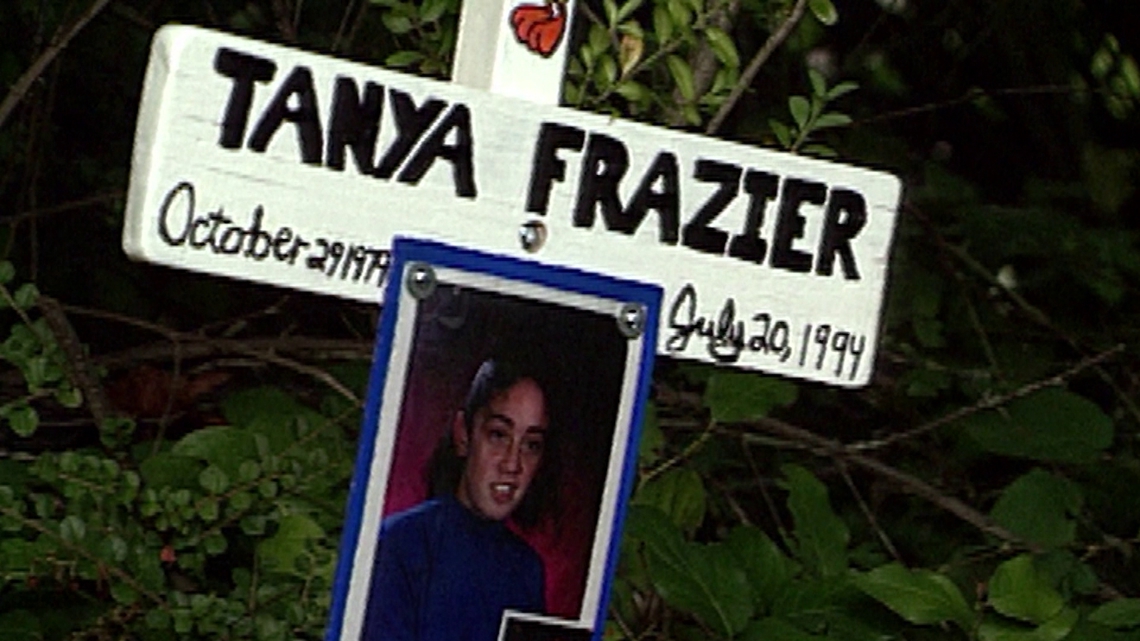
For 32 years, Tanya Frazier’s killer went unidentified — even as his DNA sat in the system designed to catch him. KING 5 Investigators found out why.

SEATTLE — Teara Frazier still thinks about who her sister would have become.
“When I think about her,” she said, her voice breaking. “(I think) just who would she be?”
In July 1994, 14-year-old Tanya Frazier vanished after leaving summer class at Meany Middle School in Seattle. Five days later, her body was found along East Highland Drive, blocks from where she was last seen. She had been sexually assaulted and suffered sharp force injuries. No one knew who was responsible.
The case went cold. Seattle Police couldn’t find a match to the male DNA found on Tanya’s body.
“It makes it hard to trust people. Who was this person?” asked Teara. “And did we trust them and they did this?”
What Teara didn’t know – what her family couldn’t have known – was that the man now accused of killing Tanya had already been in the system. Years before Tanya was murdered, police had collected his DNA. It had, eventually, been entered into the national database designed to make exactly this kind of match.
And still, for more than 30 years: nothing.
KING 5 Investigators spent months examining why. What we found reveals the limits, and now evolution, of a forensic system that thousands of families depend on.
THE ARREST
In November 2025, the call finally came. There had been a match. And an arrest.
“I stood there,” Teara said. “Just stood there. And started bawling. And then I was like, I don’t even know – I’m not sad. But I’m definitely not happy. It was just so emotional.”
Seattle Police arrested 57-year-old Mark Anthony Russ and charged him with first-degree murder in the death of Tanya Frazier. Investigators found that in 1994, his mother lived across the street from Meany Middle School – Tanya’s last known location. His bail was set at just under $1 billion.
Russ is an “unregistered sex offender with numerous arrest and felony convictions,” court records state, including a felony for attempted rape. He spent 25 years in prison, records show. In Tanya’s case, he’s pleaded not guilty.
When Teara saw his photograph, she studied it for a long time.
“It was just like, ‘This is the person,'” said Teara.
Her gratitude at finally having answers is also complicated by a harder question. “There’s a lot of gratitude. I’m so grateful they didn’t give up on this,” said Teara. “They did solve this. But why did it take so long?”
THE DNA TRAIL
The break in the case came down to DNA, Seattle Police said. But that answer brought Teara more confusion since DNA evidence had existed from the very beginning.
“From day one there was DNA. You have skin under her nails, you have semen, that seems like more than enough to be able to identify somebody,” said Teara.
Investigators had DNA from the scene. And under Washington state law, a felony conviction requires DNA collection. Russ was first convicted of a felony in 1991 – three years before Tanya was killed. Police collected his DNA sample as required. KING 5 Investigators confirmed, eventually, the collection went as it was supposed to.
So, why was there no match between these two?
“[The DNA from the crime scene] should go in and get into the CODIS databank,” said Cloyd Steiger. “If there’s somebody in there that has that DNA, it’ll hit. It’ll go, ‘This is the person.'”
CODIS – the FBI’s national DNA database – is the system law enforcement agencies across the country use to match crime scene evidence with known offenders. Retired Seattle Police Homicide Detective Cloyd Steiger, who worked on Tanya’s case, described it simply: if someone is in there, and their DNA matches, the system flags it.
Russ was in there. Yet, no match.
NINE ATTEMPTS
KING 5 took its questions to the agency responsible for DNA collection and testing in this state: the Washington Crime Lab. What we found was a system that had tried, repeatedly, to solve Tanya’s case.
Chris Loftis of the Washington State Patrol walked us through the timeline. Washington was among the first states in the country to establish a DNA lab, in 1990 and 1991, and among six states chosen as pilot partners when the FBI began developing what would become CODIS. Russ’ sample was collected in that early wave, making it one of the first in the state system.
But CODIS didn’t formally launch until 1998. It took time to digitize the DNA on file, Loftis explained, and Russ’ sample was entered into the national database in 2001. When there wasn’t a match, investigators tried time and time again.
“Nine different times we had requests for new testing. Nine different times we responded to that request,” said Loftis. “And the last one worked.”
The DNA sample recovered from Tanya’s body was “mixed,” Loftis said, meaning it contained DNA from more than on person. For decades, technology couldn’t separate them.
New technology has now allowed forensic scientists to be able to separate the male DNA from female DNA in Tanya’s case.
From 1991 to 2025, Russ’s DNA sat in the system — as investigators made nine attempts to match it to Tanya’s case.
“When we can zero in on just that, and test just that, and run just that through this thing – it doesn’t confuse the system, it clarifies the system,” said Loftis.
Loftis also credits the amount of DNA needed. What once required a larger dime or nickel size sample, can now be done with a trace, a touch, or cough, leaves enough for modern analysis. This allows investigators to be able to do more with smaller DNA samples. Cases that once seemed impossible to crack are being revisited.
OTHER VICTIMS?
For those closest to Tanya’s case, the breakthrough also raises a troubling question: were there others?
“I would be very surprised if he had not done this other times,” Teara said. “Like, very surprised.”
Rose Windquist, the private investigator for the Frazier family, put the concern in concrete terms.
“What if – just as an example – he potentially raped other women?” asked Windquist. “And what if their rape kits got entered into the system, but because of the statute of limitations – back in the 90s it was three years, now it’s eight years – what if that DNA (in) that rape kit is gone because it doesn’t matter anymore?”
For years, Washington had a massive backlog of untested rape kits. If it took decades to identify Russ in Tanya’s case, insiders acknowledge, others may have been missed.
“I’m sure there are cases out there, and perpetrators out there, that benefitted from that situation,” said Loftis.
But new technology is changing the calculus. For those who believe their past crimes are safely buried, Loftis has a message: “There may be somebody out there who did something bad 20 years ago, 30 years ago, 40 years ago. We’re going to knock on your door someday. Be afraid. Be afraid, because we’re coming. We don’t give up.”
The Frazier family has never stopped pushing for answers. Teara hopes others in similar situations won’t stop either.
“I do hope that everyone in a similar situation does get answers,” said Teara. “Not knowing is torture.”

To ensure diverse coverage and expert insight across a wide range of topics, our publication features contributions from multiple staff writers with varied areas of expertise.
