
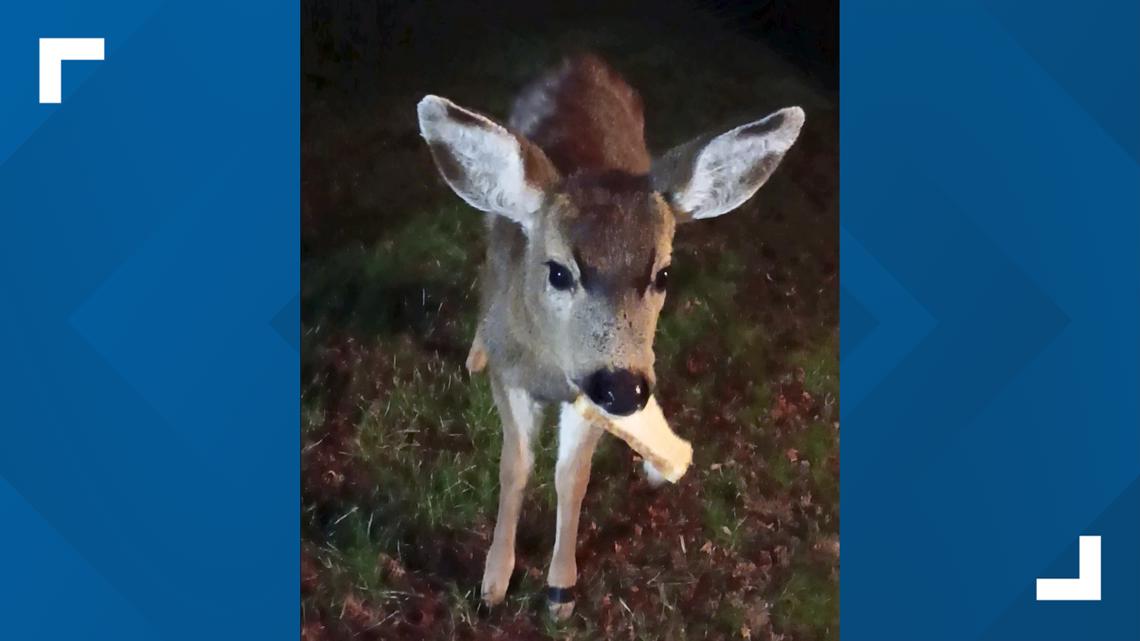
“This thing is hobbling around, and the foot is infected. I’m not going to wrestle a deer. So, what do I do now?”

OAK HARBOR, Wash. — A young deer on Whidbey Island has become the focus of a neighborhood effort to find veterinary care, after residents noticed a piece of PVC pipe lodged around one of its legs.
Robert “Bob” Ramsey, a longtime Whidbey Island resident, said he first noticed the pipe about a month ago on a deer born in the neighborhood less than a year ago. At first, he hoped the pipe would fall off on its own. Instead, he believes the animal’s condition has worsened as it has continued to grow.
“This thing is hobbling around, and the foot is infected,” Ramsey told KING 5. “I’m not going to wrestle a deer. So, what do I do now?”
Ramsey said he has spent weeks contacting wildlife agencies, veterinarians and neighbors in hopes of finding someone able to help the animal.
“I’ve been the primary person involved with this, reaching out wherever I can,” he said.
The deer is one of two fawns born near Ridgeway Drive less than a year ago, according to community members. Ramsey said the animals regularly visit his property, where an apple tree attracts deer each year, and residents have watched the siblings grow up in the community.
As development has expanded in surrounding areas, Ramsey said deer have become a common sight in the neighborhood.
Neighbor Lori Matteson, who lives several houses away, said residents first became aware of the problem last fall.
“I’ve seen it up close. It’s clearly PVC pipe,” Matteson said.
Matteson said the deer can occasionally be approached from a short distance away, but not closely enough for anyone to safely remove the pipe.
“It had a real bad limp,” she said. “It’s getting worse because it’s swollen. It’s growing.”
Matteson suspects the animal may have stepped through recent construction debris in the area, though the exact cause remains unknown.
Both neighbors said they have sought help from wildlife officials. Matteson said she contacted wildlife authorities, including the state Department of Fish and Wildlife, several times but was unable to find a path forward.
Ramsey recently turned to social media as a last resort, hoping someone in the community could connect him with a veterinarian willing to help.
Ramsey said the deer still tries to keep pace with its mother and sibling, but appears partially lame. He said he has tried to lure the animal close enough for help but has never been able to get close enough to safely intervene.
“I don’t think the neighbors want to see it anymore. It’s not going to be able to walk,” Ramsey said. “It got to a point where I had to do something.”
Matteson said she fears the animal will continue to suffer if the pipe is not removed.
“This guy needs help,” she said. “I’d hate for it to die a slow, painful death.”
Both neighbors said they believe a veterinarian could potentially help, if the deer could be safely tranquilized long enough to remove the simple plastic.
“The poor guy is SUFFERING daily,” Ramsey wrote in a social media post seeking assistance.
Update: Tuesday, May 26
A spokesperson wrote back to KING 5 several days after this story was published, noting that a wildlife specialist would visit the Oak Harbor area on Wednesday to locate the deer, assess its condition, and “hopefully remove the PVC.”
“We’ve been looking into this with our Island County wildlife biologist and wildlife conflict specialist. At this time we cannot confirm any recent reports submitted to WDFW regarding a deer on Whidbey Island stuck in PVC pipe,” the spokesperson said. “WDFW prioritizes reports based on factors including urgency, public safety, and wildlife conservation need.”
They also clarified some of the relevant circumstances surrounding the treatment of black-tailed deer in a jeopardized condition such as the one on Whidbey.
“The public should call 911 for immediate assistance in an emergency, especially on or near a roadway. Adult deer do not adapt well to captivity, which can cause extreme stress, so they are not rehabilitation candidates. Transporting and housing deer could also lead to chronic wasting disease concerns,” they said.
In the event of an immediate public safety issue, wildlife violation or an injured or dangerous animal, WDFW advises people to contact its Enforcement Office at 360-902-2936, email [email protected] or call 911. Injured wildlife can also be reported here.

To ensure diverse coverage and expert insight across a wide range of topics, our publication features contributions from multiple staff writers with varied areas of expertise.
