
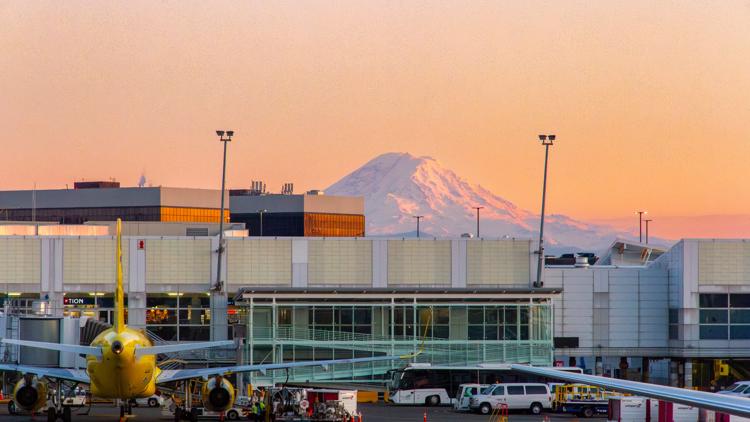
A new report identifies “approximately 27 million annual passengers still needing accommodation in the region” after factoring expansions at both SEA and PAE.

SEATTLE — New state forecasts show the Puget Sound region is on track to exceed the long-term capacity of its commercial airports by roughly 27 million annual passengers by 2050, a gap planners acknowledge cannot be closed with currently planned expansions alone. Where those travelers will go remains an open question.
The Washington State Department of Transportation’s (WSDOT) updated Washington Aviation System Plan projects unconstrained passenger demand in the Puget Sound region could reach roughly 107 million annual passengers by 2050.
Even with planned expansion projects at Seattle-Tacoma International Airport (SEA) and Paine Field Airport (PAE), the two airports together are projected to handle about 67 million passengers annually.
After accounting for travelers who may divert elsewhere, the report still identifies “approximately 27 million annual passengers still needing accommodation in the region.”
Analysts note that those projections are based on data taken during recent years of widespread economic growth in western Washington, and that, of course, no one has a crystal ball.
SEA remains the center of the region’s aviation system and is pursuing a massive expansion plan that includes a second terminal with 19 gates, roadway improvements and new cargo facilities.
The FAA has finished a federal review process for that growth strategy, and its paired, state-level component will likely conclude by the end of 2026, according to a spokesperson.
SEA served 52.7 million passengers in 2025, and state planners say it is running out of room.
The WASP found SEA’s future terminal buildout would still fall about 6 million passengers short of projected 2041 demand. The report says the airport “will have difficulty expanding beyond what is currently planned, given the layout and location of the airport.”
“[SEA] is oversubscribed,” Kent Craford, CEO of SeaPort Airlines, told KING 5. “Everything needs to go just right for its machinery to continue turning.”
That leaves Paine Field as the region’s primary relief valve.
Paine Field’s long-term plan envisions 4 million annual passengers by 2040, with expanded terminal space and up to 15 gates. But the WASP suggests the airport may ultimately need to absorb far more traffic than currently planned.
Snohomish County recently finalized that expansion strategy, and it is actively working to implement its elements, according to a spokesperson. However, the operator and owner of the terminal, Propeller Airports, can move ahead with the construction on its own time.
WSDOT’s report found that if excess SEA demand shifted north, annual passenger demand at Paine Field could rise to 6.7 million passengers, requiring a terminal roughly “63 percent greater than the airport’s ultimate planned terminal size.”
A spokesperson attributed any discrepancies in the two data projections to the recency of WSDOT’s report.
Meanwhile, Boeing Field officials say the airport is too small and too constrained by surrounding development to absorb major commercial growth.
“We certainly would not be able to absorb the kind of growth in passenger numbers that state aviation planners expect in the coming years,” airport officials said in a statement.
Instead, Boeing Field is expected to remain focused on smaller commuter airlines, cargo operations and private aviation.
That leaves few obvious options for handling the region’s long-term aviation growth.
The Legislature-created Commercial Aviation Work Group is expected to release recommendations later this year on how Washington should address the growing capacity needs.
“The longer-term gap, beyond 2040, is really what the CAWG is working on now,” Evan Nordby, CAWG chair, told KING 5.
But industry leaders say the private market may ultimately adapt faster than the state can build infrastructure.
Alaska Airlines may increasingly shift connecting traffic through Portland instead of Seattle, Craford said. Alaska CEO Ben Minicucci described Portland International Airport as a “relief valve” for Seattle congestion in 2025.
“The airlines are going to be highly motivated to solve these problems themselves,” Craford continued.
One potential solution that does not appear in any documents: the possibility of an entirely new airport.
“The airports we have are the airports we will continue to have for the rest of our lives,” Craford concluded.

To ensure diverse coverage and expert insight across a wide range of topics, our publication features contributions from multiple staff writers with varied areas of expertise.
