
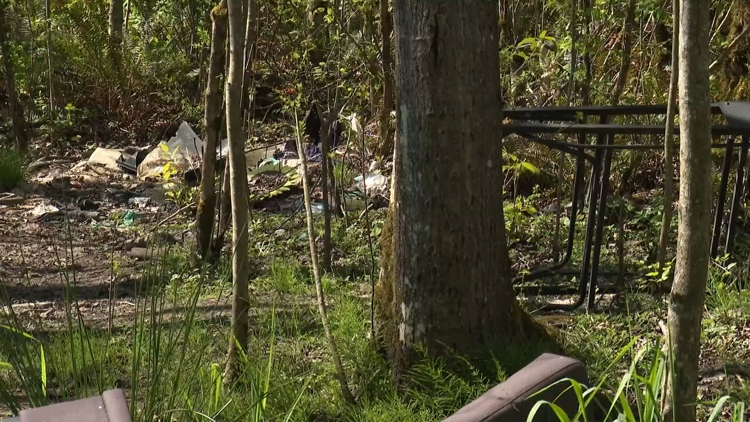
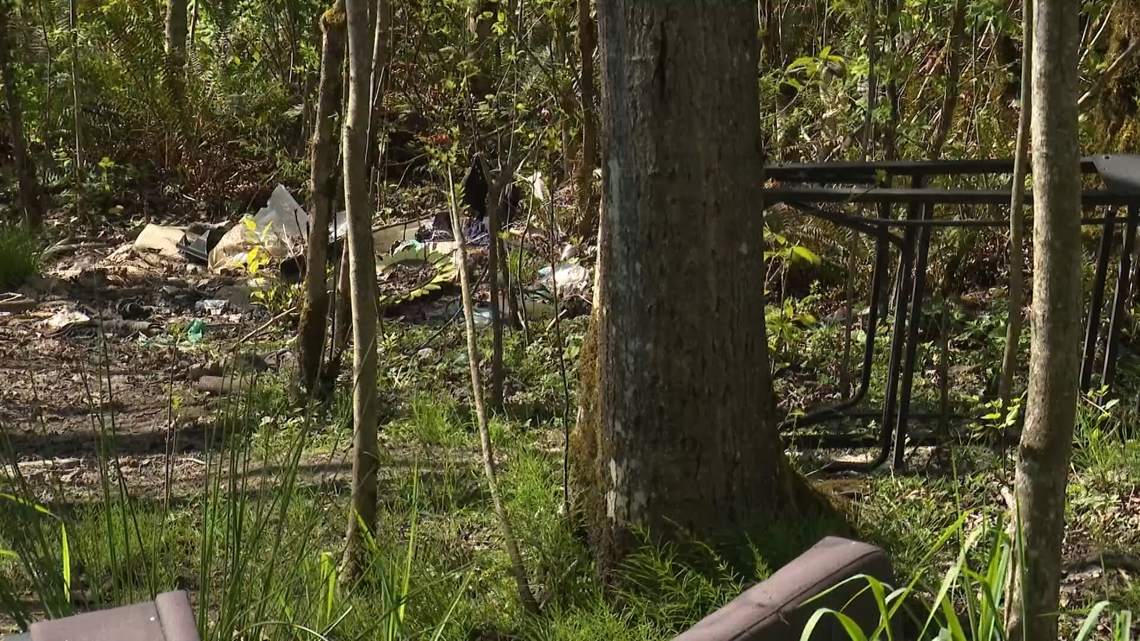
A Kent wetland that drains into Puget Sound is filling with trash, but no single agency is responsible for cleaning it up with land split between multiple owners.

KENT, Wash. — A sprawling wetland in South King County that drains into Puget Sound has become a dumping ground in places, and officials say cleanup is complicated by a patchwork of public and private ownership.
The 130-plus-acre site, known locally as the Woodmont Wetlands and referred to by the city as the McSorley Wetland. It sits between Pacific Highway South and South 272nd Street, near Woodmont Park and the Star Lake light rail station. The wetland feeds McSorley Creek, which flows into Puget Sound at Saltwater State Park.
Mark Hitchcock, a local blogger and scuba diver, began documenting conditions there months ago after becoming concerned about safety along nearby roads where his son and others walk.
Hitchcock said he has found widespread trash, including discarded clothes, furniture, and needles, among other debris, scattered across the wetland.
“I’ve been kind of a squeaky wheel and I’ve talked to a lot of people,” Hitchcock said, describing efforts to alert local leaders and agencies. He said those efforts often led to dead ends.
“It feels like nobody wants to take accountability,” Hitchcock said.
According to Seattle & King County Public Health, the department responds to illegal dumping complaints on private property by assessing conditions, identifying responsible parties and coordinating with local jurisdictions. It said cities are the lead agency for enforcing illegal dumping laws within their boundaries and has notified Kent about the site.
The City of Kent said the wetland includes a mix of city-owned land, private property and other publicly owned parcels. The city manages about 50 acres and has conducted multiple cleanups there, officials said.
“Kent Public Works, in coordination with our Police Special Operations Unit, has conducted regular site visits and inspections of City-owned parcels,” a spokesperson said. “These efforts are focused on identifying and addressing illegal dumping, encampment-related debris, and other environmental impacts as they arise.”
“Like many jurisdictions across the region, we are seeing challenges related to illegal dumping and unmanaged encampments. These can create environmental and public health concerns, including hazardous waste such as syringes, drug paraphernalia, human waste, and general refuse. We take these risks seriously and respond with coordinated cleanup efforts and ongoing monitoring.”
For privately owned portions, the city said it uses code enforcement to require maintenance, including issuing notices and warnings that can escalate to fines or misdemeanor charges if violations are not addressed.
City officials said they sent letters to known property owners in March outlining expectations for compliance and have conducted inspections and site visits in coordination with police.
They also acknowledged ongoing challenges tied to illegal dumping and encampments, which can create environmental and public health concerns, including hazardous waste such as syringes and human waste.
But with multiple owners, no single agency is responsible for cleaning the entire wetland.
Hitchcock said relying on private property owners to address the problem is not enough.
“At some point, relying on private property owners and enforcing private property owners — it seems like more needs to be done in that regard,” Hitchcock said.
The city said additional inspections and cleanups are planned and that it will continue working with property owners and regional partners. Officials also encouraged residents to report concerns so crews can respond where the city has authority.

To ensure diverse coverage and expert insight across a wide range of topics, our publication features contributions from multiple staff writers with varied areas of expertise.
