
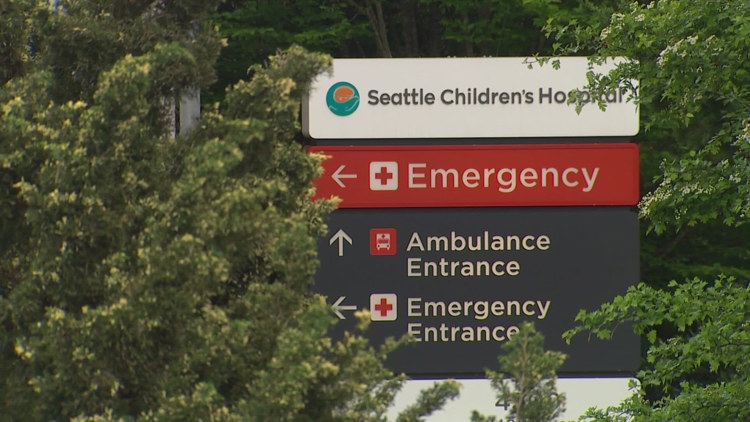
The hospital says some limits on helipad access add pressure when children need lifesaving care.

SEATTLE — Seattle Children’s Hospital says ongoing efforts by some Laurelhurst residents to limit helipad access are adding strain to emergency transports for children who need lifesaving care.
Helicopters flying children to Seattle Children’s have to weigh whether a transport is urgent enough to land at the hospital or whether to land a mile away and take the patient by ambulance because of noise concerns in the surrounding neighborhood.
In a statement Tuesday, the hospital said it receives “3 or fewer helicopter transports per week” and that nearly all of those patients are admitted to an intensive care unit.
“Every second counts when a child needs lifesaving care and Seattle Children’s will always put the health and safety of our patients first. Most members of the Laurelhurst community are supportive and grateful for the services and care Children’s has delivered for decades. However, ongoing efforts by some to restrict helipad access puts an unnecessary burden on the system. For context, Children’s receives 3 or fewer helicopter transports per week and nearly all are admitted to an intensive care unit. We are eager to revisit the voluntary agreement Children’s has been operating under and welcome the support of community members or city leaders who would like to join the conversation.”
The hospital posts helicopter landing reports every six months. The issue has also come up for years at meetings of the Seattle Children’s Implementation Advisory Committee, which is run through the city of Seattle’s Office of Planning and Community Development.
The committee meets sporadically, with its most recent meeting held in October 2025.
At an August 2020 meeting, Colleen McAleer commented on the hospital’s helicopter service, saying the aircraft were louder and were often landing on top of the building.
The notes from that meeting said neighbors had reported helicopters traveling “right along the Avenue and in the neighborhood,” and that the intent was not to have helicopters flying very close to homes.
The meeting notes also said there had been fewer landings in the athletic field and that almost all landings were happening on top of the building. It was suggested at the meeting that the helicopter company attend a future committee meeting.
The concerns date back decades.
According to HistoryLink, the Seattle City Council approved a helipad at Children’s on Sept. 28, 1992, after eight years of conditional use review and an environmental impact statement.
The helipad was described as a way to bring critically ill patients from across western Washington directly to care, saving hours compared with travel by ground.
As part of a compromise with neighbors, most flights were directed to a marked and lighted helipad at Graves Field at the University of Washington unless special circumstances required a landing at the hospital, according to HistoryLink.
A Helicopter Advisory Committee, including doctors, community members and city and county officials, reviewed the clinical reason for each landing decision.
A 2007 Seattle Times story described the broader tension between Seattle Children’s and the Laurelhurst neighborhood as the hospital pursued a major expansion.
The Laurelhurst Community Club raised concerns that the hospital’s growth would worsen congestion and affect the residential neighborhood, while hospital leaders said they needed more space to serve children from a large regional area.
The helipad issue resurfaced in 2018 when Seattle Children’s moved its helistop from a ground-level location to the rooftop of the Forest A building, also known as the Friends of Costco Building.
The Laurelhurst blog wrote at the time that the hospital had advised residents that noise would likely be louder than it had been at the former ground-based helipad near the emergency room.
The Laurelhurst Community Club also wrote in a 2018 newsletter that the rooftop location was expected to make noise more intense for some nearby residents because the previous ground-level location helped shelter the sound.
The group said it would continue to monitor the issue and work with Seattle Children’s.
The hospital’s helistop was later planned to move permanently to the top of the Forest B building as part of Seattle Children’s expansion.
The 2018 newsletter said that noise levels would remain higher at nearby residential sites in Laurelhurst once the move was complete.
Seattle Children’s said Tuesday it wants to revisit the voluntary agreement that has guided its helipad operations and is inviting community members and city leaders to join that discussion.

To ensure diverse coverage and expert insight across a wide range of topics, our publication features contributions from multiple staff writers with varied areas of expertise.
