
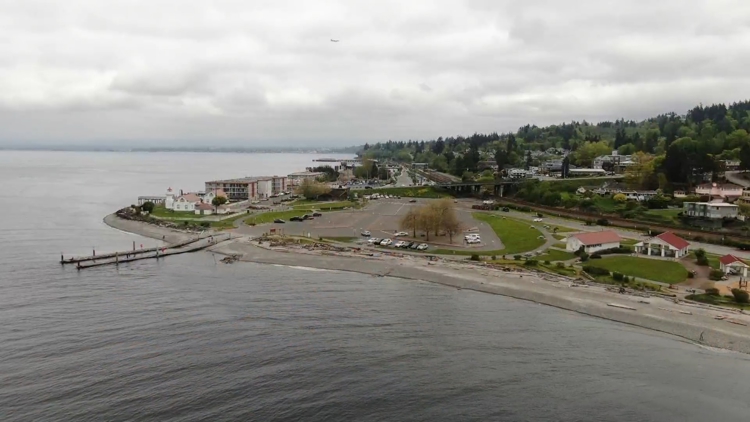
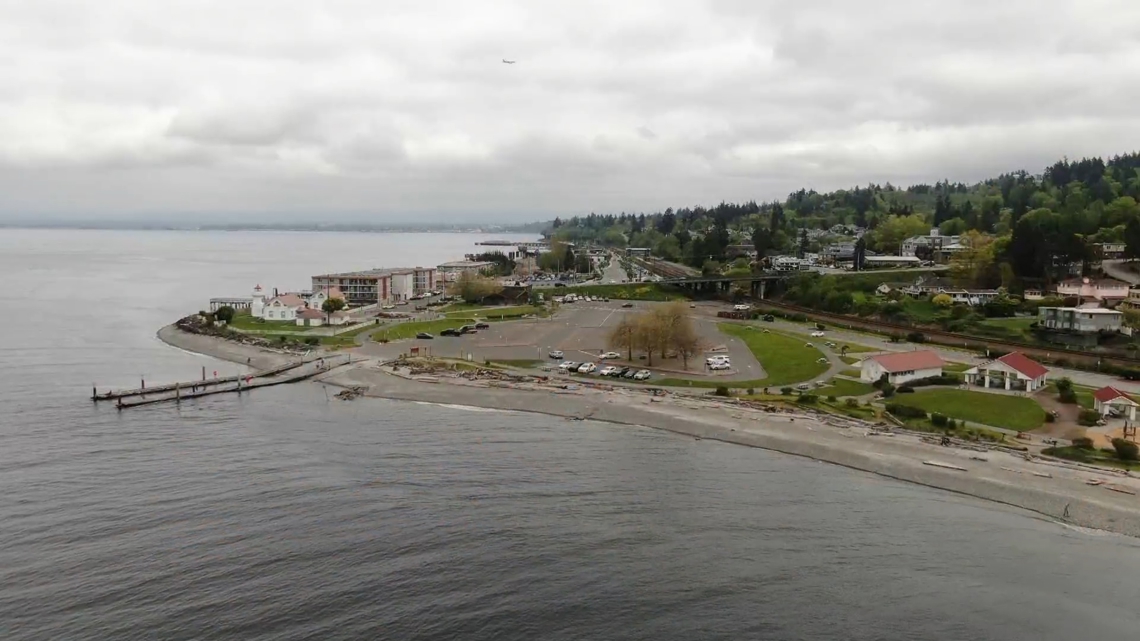
The Mukilteo City Council is weighing how often to read a Native land acknowledgment — a debate that cuts to the heart of how a treaty city reckons with its past.

MUKILTEO, Wash. — A debate is unfolding in Mukilteo over whether to scale back land acknowledgments the City Council has read before every meeting since 2022.
The acknowledgment, a spoken recognition of Native American history and sovereignty, has become standard practice at many city halls across western Washington. But in Mukilteo, some residents and council members are pushing to limit the recitation to once per quarter or once per year.
The debate is playing out against a historically significant backdrop. Mukilteo is where the Point Elliott Treaty was signed in 1855. The agreement forced Native Americans onto reservations in exchange for hunting and fishing rights as settlers worked to systematically erase Native culture. The city’s name itself is a Snohomish word, and it sits at the heart of Snohomish ancestral territory.
For James Madison, a Native American who walks the shores of Mukilteo feeling the weight of that history, the acknowledgment matters deeply.
“It shows respect. It shows empathy, and I believe America right now needs a lot of empathy,” Madison said.
Madison said his ancestors lived on this land for thousands of years before colonization.
“Our land was taken from us. They tried to take my culture,” he said. “I don’t think anyone can understand that, let alone justify it, or know what it feels like generation after generation after generation.”
The council adopted the acknowledgment in 2022, in the aftermath of the George Floyd uprisings, as a gesture recognizing Native rights and past injustices. But resident Sharon Damoff has been a vocal opponent, regularly speaking out at council meetings.
Damoff said she has nothing against Native people but believes the acknowledgments are part of a political agenda that fosters division.
“I think land statements are part of a broad movement to undermine America,” she said. “It’s intended to make it sound like we’re a bad country. We’re a good country. We’ve brought liberty and prosperity to millions. I think it’s intended to delegitimize our country.”
Damoff said she would rather focus on the future than relitigate the past.
“I want us to be friends now, flourish together, treat each other with respect. I think we will get a lot further toward that goal than by continually looking back at something and saying that was bad.”
Madison disagrees. “There’s no ‘bygones.’ There is no ‘let’s move on,’” he said, adding that limiting the acknowledgment would only deepen the divide between the two worlds he navigates daily.
“To be human is to show understanding of other people’s situations,” Madison said. “To acknowledge the people who are from this very land is very important, and it shows respect to my people at the highest level.”
The Tulalip Tribes also weighed in, with Tribal Chairman Hazen Shopbell issuing a statement defending the practice.
“Tulalip and Mukilteo have long built a government-to-government relationship founded on respect, integrity and responsibility,” Shopbell said. “Land acknowledgments are a good-faith reminder, a way to educate and remember the Indigenous people and the history of this land. Sovereign Indigenous nations have always existed and governed here.”
Shopbell added that the Tulalip Tribes view acknowledgments as a foundation, not a formality.
“We see land acknowledgments as a starting point for more meaningful interactions and government-to-government relationships,” he said. “Tulalip will continue to work toward good interactions with the governments and communities in our territories.”
The council is not debating eliminating the acknowledgment entirely — only how often it is recited. A vote is expected at next Monday’s City Council meeting on May 4.

To ensure diverse coverage and expert insight across a wide range of topics, our publication features contributions from multiple staff writers with varied areas of expertise.
