
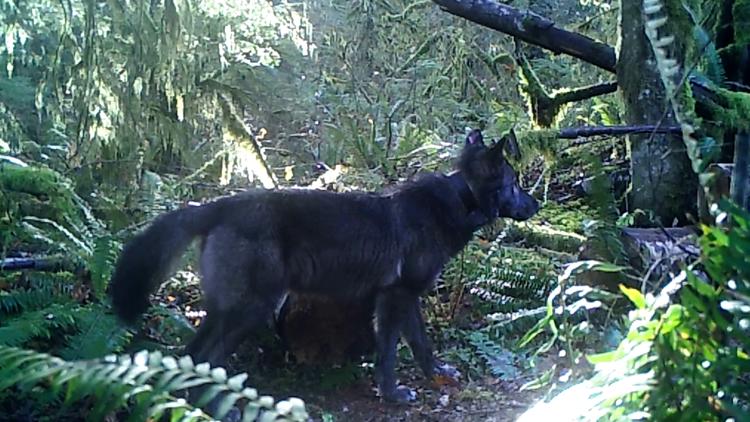
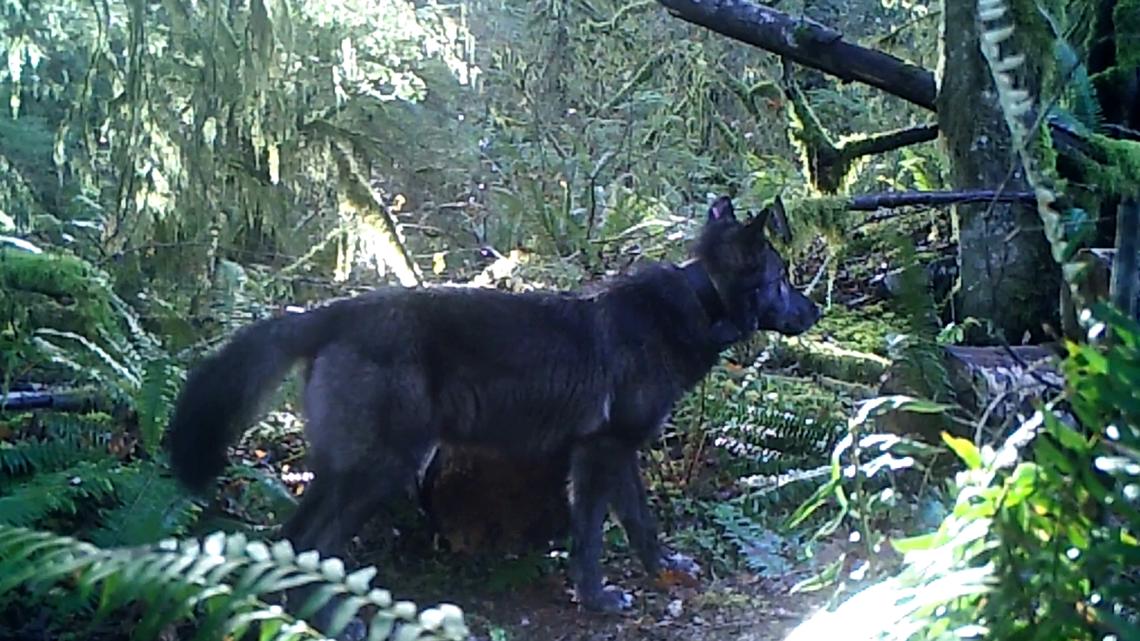
During the summer and early fall of 2025, a single uncollared wolf was documented consistently using an area near Mount Adams.

CONCRETE, Wash. — Washington state’s wolf population is at its highest level to date since its decimation in the early 20th century, but packs remain primarily concentrated in eastern Washington, raising questions about when — or if — they will return to the western side of the Cascade Range.
“Someday there will be more wolves on the western side of the state,” said Gabriel Spence, a wolf biologist with the Washington Department of Fish and Wildlife.
Spence noted that in recent years, a “small pack” occupied the northern end of the western side of the state but has since “petered out.”
That pack was the Diobsud Creek pack in Skagit and Whatcom counties. Its history dates to 2017, when WDFW observed a single wolf in the territory. A second wolf joined in 2018, forming the Diobsud Creek pack, which is defined as at least two animals. By 2019, the area again held just a single wolf, a pattern that continued until the animal disappeared sometime in 2023, according to Spence.
More recently, during the summer and early fall of 2025, a single uncollared wolf was documented consistently using an area near Mount Adams.
“We’ve had single travelers on the west side before; they come back to the eastside eventually,” Spence said.
WDFW did not identify any other wolf activity in the Southern Cascades or Northwest Coast Recovery Region during the calendar year.
If wolves do return to more densely populated areas, they are not expected to pose a major risk to people, according to WDFW wolf biologist Trent Roussin.
He said the most common conflicts involve livestock, and advised recreators to take precautions.
“For the average recreator, if you’re recreating in a place where wolves might be around, keep your animals close and your dog on a leash. Make noise,” Roussin said.
“If you see a wolf, enjoy it. It’s extremely rare that someone would encounter a wolf,” he added.
Roussin noted that wolves may occasionally bark at humans, “which can be intimidating, but it’s not a huge safety concern.”
The state’s wolf population reached a new high at the end of 2025, according to the Washington Gray Wolf Conservation and Management Annual Report. The minimum year-end count increased by more than 17% after a decline the previous year.
WDFW, working with tribes, counted 270 wolves, 23 breeding pairs and 49 packs statewide. Pack sizes ranged from two to 12 wolves, with most consisting of three to seven animals.
“We confirmed six new or reestablished packs in the annual count,” Roussin said. “Those that reestablished include the Salmo, Smackout, and Vulcan packs in northeast Washington. New packs include the Cameron Lake pack on the Confederated Tribes of the Colville Reservation and the Billy Goat and Tupshin packs in the North Cascades Recovery Region.”
Despite that growth, recovery remains uneven across the state. The Southern Cascades and Northwest Coast Recovery Region still have no confirmed packs or breeding pairs, according to the report.
WDFW tracks wolves through footprints, aerial surveys and cameras. The figures represent a minimum count of wolves in packs, plus an additional 12.5% estimate for lone wolves that are harder to document.
KREM’s Grace Uppendahl contributed information for this report.

To ensure diverse coverage and expert insight across a wide range of topics, our publication features contributions from multiple staff writers with varied areas of expertise.
