
The Ballard Link Extension would draw the most riders of any planned expansion — but its over $20 billion price tag has made it a target for cuts.

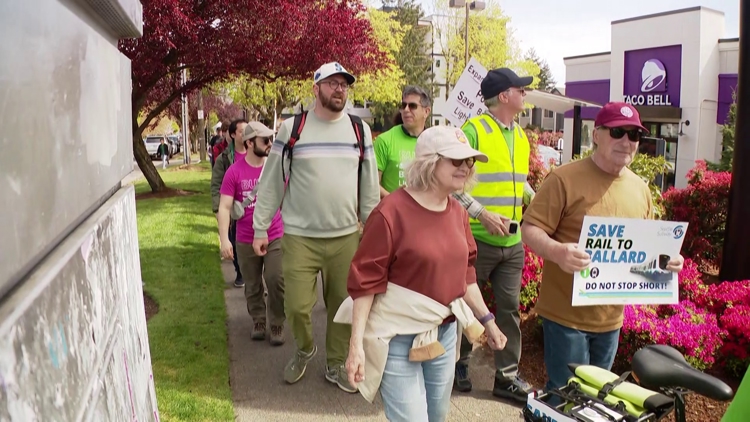
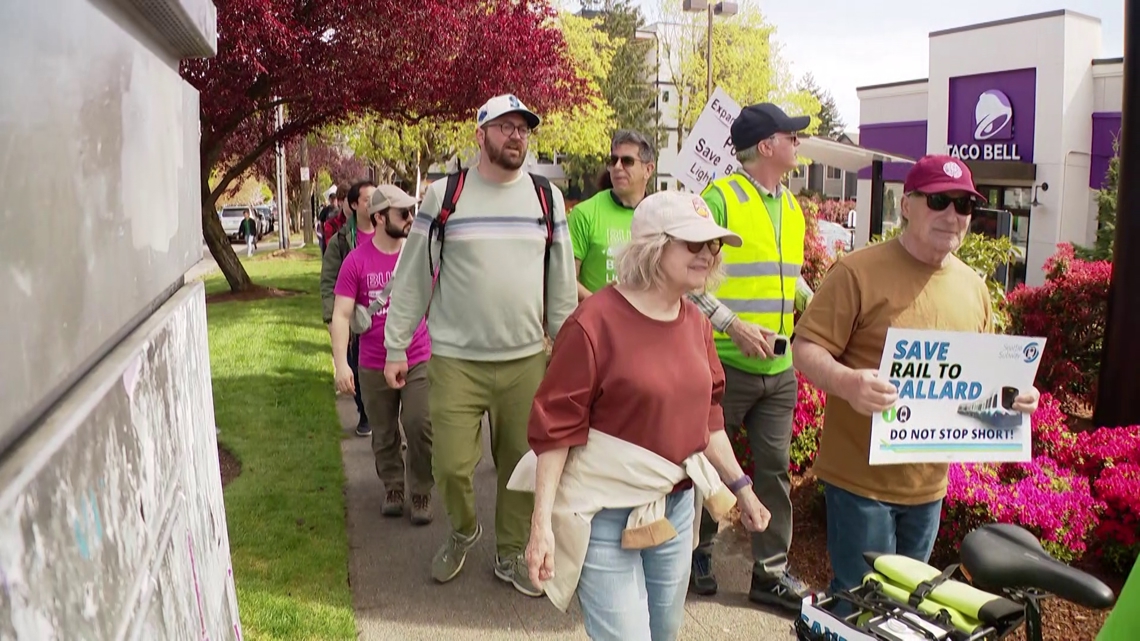
SEATTLE — Hundreds of Seattle residents marched through Ballard on Sunday to protest potential cuts to a light rail extension voters approved nearly a decade ago, with elected officials joining calls to hold Sound Transit accountable.
For Abraham Williams, getting to the rally was itself proof of the point. The Central District resident spent 50 minutes riding two buses to reach Ballard.
“I love this neighborhood, and it’s hard to get to the Central District without a car,” Williams said.
The demonstration, organized by Save Ballard Rail — a group that formed just two weeks ago — began at Gemenskap Park and wound through city streets, crossing the Ballard Bridge to the proposed Interbay station site before ending at Smith Cove along the Elliott Bay Trail.
The Sound Transit board last month received three potential scenarios to address a $34.5 billion agencywide funding shortfall. All three would stop the Ballard light rail extension short of its promised terminus at 15th Avenue and Market Street, ending instead at either Seattle Center or Smith Cove.
Seattle City Councilmember Alexis Mercedes Rinck drew a firm line Sunday.
“We know that Sound Transit has real problems. Inflation is real, construction costs are real, tariffs are real,” Rinck said. “We are not here to pretend the math is easy — but we are here to say you do not solve a financial crisis by breaking the trust with the people who funded you.”
Councilmember Dan Strauss, who represents Ballard and sits on the Sound Transit Board, made the same argument at last month’s board retreat.
“I say that it is unacceptable that we do not have a plan to get to Ballard,” Strauss said. “None of these approaches maximize ridership.”
He also noted that Ballard has been rezoned three times since ST3 passed in 2016, meaning current ridership projections are already outdated. The extension is projected to draw between 132,000 and 173,000 daily riders — more than triple the ridership expected on the East Link Extension, Strauss said, adding that the project would deliver some of the lowest costs per new rider of any expansion in the agency’s history.
Even so, the project’s scale makes it a target. Even after cost-saving measures, the Ballard extension could exceed $20 billion — more than twice the cost of other planned extensions.
For Hallie Hominda, who bought a Ballard home four years ago counting on light rail, the uncertainty stings.
“I used to always joke that maybe once we have kids, we’ll be able to move to UW by light rail,” she said. “But now that we won’t have light rail at all, it’s so disappointing.”
She said she isn’t demanding an overnight fix. “Just to have a plan in place that we know won’t be taken away would be nice,” Hominda said.
Organizer Carl Aslund pushed back against what he called a false choice framing the public debate.
“There’s been a large narrative of it’s either Ballard or West Seattle, or if we get it then Issaquah misses out — and we think that’s wrong,” Aslund said. “Everyone in the city knows it is hard to get here.”
Ballard residents have been paying hundreds — sometimes thousands — of dollars annually in car tab fees to fund the regional rail system. In some precincts, nine in 10 voters backed ST3 in 2016.
State Sen. Noel Frame, who lives in Ballard, also attended the demonstration.
“We were promised this. We paid for it. We have shown up every single time — and we will have the highest ridership out of the entire system. That makes the whole system work better for the entire region,” Frame said.
In a statement to KING 5, Sound Transit said it recognizes those marching in support of public transit and that the agency is looking for a “sustainable path forward.”
“To proactively address the estimated $34.5 billion needed to fully fund the ST3 program approved by voters, Sound Transit launched the Enterprise Initiative. This is a comprehensive, holistic approach to solving affordability challenges that considers all agency costs, including system and project planning, capital construction, service operations, system maintenance and potential revenue sources to plan a sustainable path forward. Following last month’s board retreat, a range of potential cost-saving measures and program adjustments have been identified. The board is expected to consider these options in the coming months, with decisions anticipated in May or June on how to move forward.”

To ensure diverse coverage and expert insight across a wide range of topics, our publication features contributions from multiple staff writers with varied areas of expertise.
