

For years, COVID has been blamed for America’s declining student performance. Falling test scores, widening learning gaps, and struggling readers have all been traced back to the pandemic. Dennis DiNoia disagrees. The problem, DiNoia argues, is the machine those teachers have been asked to operate. And the 2025 Nation’s Report Card—showing 13-year-olds performing at 1971 levels in math and reading—is not evidence that COVID broke something. It is evidence that something was broken long before anyone had heard of a coronavirus.

What COVID Actually Revealed
When schools closed in 2020, something became visible that had always been true. Students who had spent years being taught to receive information had no idea what to do when the delivery stopped. The teacher and the classroom were gone. The routine that told them when to sit down and what to think about was gone. And without all of it, a significant number of students simply stopped.
“Those students were not failing,” DiNoia says. “They were doing exactly what school had taught them to do for years. Wait to be told what comes next. And when nobody told them, they waited.”
His own platform told a different story. During the same years that public school scores were declining, his Conquer the CAASPP test prep program for California charter school students showed statistically significant improvements in both math and ELA—two consecutive years, measured against comparison groups of thousands of non-participating students. The model, he says, is the thing we should focus on.
“Our students kept learning because they had been taught to own their learning,” he says. “When everything shut down, there was nothing to take away from them. They already had it.”
The Wrong Diagnosis
DiNoia started teaching in 1988. His first classroom was a dropout prevention program—kids the system had essentially given up on. What he saw then has not changed in 35 years.
“Those students were not kids who didn’t have a reason to learn,” he says. “They were kids who had never been taught how to think for themselves. That was not COVID. That was 1988.”
The framing of the current data as a pandemic story, he argues, is not just inaccurate, but dangerous. “It lets everyone off the hook. And it misdiagnoses the problem.” A misdiagnosis, in medicine or in education policy, does not lead to a cure. It leads to more of the same treatment that was not working in the first place.
His distinction is clear, and he returns to it often: American education is not broken. It is obsolete. “Broken implies it once worked and something went wrong,” he says. “Obsolete means it was built for a world that no longer exists and nobody has been willing to admit it.” The American classroom, as it was designed, was built for an economy that needed people who could perform the same task repeatedly. That economy is gone. The classroom largely is not.
What the Scores Cannot See
One of DiNoia’s sharpest observations is about what standardized test data is structurally incapable of capturing. The student who studied for hours and went completely blank the moment the test began. The one who decided in fourth grade that she was not a math person and never once questioned that conclusion again. The one who stopped trying not because the work was too hard, but because failing one more time felt like more than he could carry.
“The score shows up in the data,” DiNoia says. “The student does not.”
When you teach students what to think rather than how to think, he argues, every exam becomes a gamble. Did I memorize the right things? Will I remember enough under pressure? When the answer is no—and for many students, it is—the student does not conclude that they need a better strategy. They conclude that something is fundamentally wrong with them. That belief is where the anxiety lives and it follows them into every classroom, every assignment, every moment they are asked to try again.
“The NAEP data is showing the academic result of that system,” he says. “The anxiety epidemic is showing what it feels like from the inside. They are the same crisis wearing different faces.”
What Actually Has to Change
Before anything else, Dennis DiNoia wants to make one thing clear: this is not about teachers. “There are teachers across this country who have given everything they have to their students,” he says. “I have met them. I worked alongside them. I was one of them.” The problem, he argues, isn’t the people in the classroom—it’s the system they’re being asked to work within.
DiNoia is not short on recommendations. First, teach students to check their own work—not simply compare answers, but think through where they went wrong. “When a student finds the mistake themselves, that discovery matters more than any grade I could give them.” Second, stop treating grades as the ultimate outcome. A grade shows where a student ended up; the mistakes along the way reveal how they learned. Third, let students become the teacher. When they can explain a concept clearly in their own words, real understanding has taken hold.
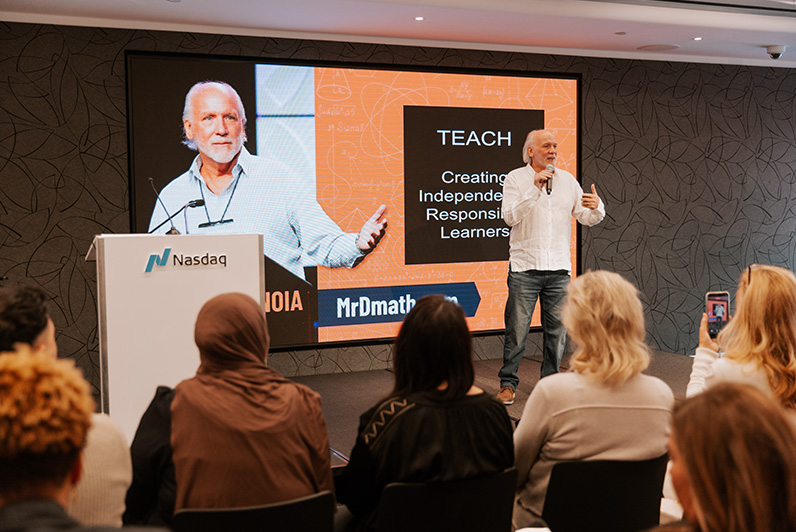
Together, these principles form what DiNoia calls the independently responsible learner—a concept explored in his book TEACH: Creating Independently Responsible Learners. Not a student who never needs help, but one who can keep moving forward when help isn’t immediately available.
His message to policymakers is straightforward: reforming an obsolete system will only produce obsolete results. The models that succeeded during COVID were not those with the most oversight, but those that taught students to own their learning. “Start there,” he says. “Ask why those models worked.”
To parents, his advice is simpler still: ask your child what they figured out today, or what mistakes they made—not what grade they received. “Asking that question changes the dynamic in ways no curriculum reform ever could.”
And to the teachers—the ones spending their own money, eating lunch with the struggling kid, refusing to let anyone fall through the cracks—his message is the one he has held since that first classroom in 1988.
“Students are capable. They are genuinely interested in learning. When we give young people the tools to discover knowledge for themselves, they will rise higher than any curriculum alone could ever take them.”
That was true before COVID. It is true now. It will be true when the next crisis arrives and hands everyone a new reason to avoid the harder conversation.
To learn more about Dennis DiNoia’s teachings, visit https://mrdmath.com/about

To ensure diverse coverage and expert insight across a wide range of topics, our publication features contributions from multiple staff writers with varied areas of expertise.
