
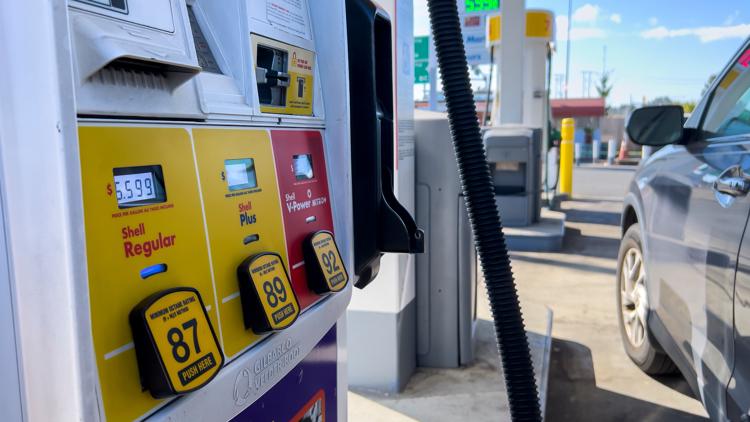
One Snohomish County station advertised gas for $4.99 per gallon with cash payment.

WOODINVILLE, Wash. — The average price of gasoline in the Seattle area fell by nearly 4 cents per gallon last week, but the trend might not hold after the cost of oil increased Sunday and again Monday, analysts say.
Seattle commuters awoke Monday morning to a gallon of gas costing, on average, $5.89, 8 cents higher than a month ago but down slightly week over week, according to Dallas-based tech company GasBuddy.
GasBuddy reported the cheapest station in Seattle was selling gas for $5.09 per gallon Sunday. KING 5 did not locate a Seattle station at that price during a review of GasBuddy listings Monday morning, though one Snohomish County station was advertising gas for $4.99 per gallon with cash payment. A nearby Costco station sold gas at $5.35 per gallon.
According to GasBuddy, historical gasoline prices in Seattle and the national average going back five years were:
- June 1, 2025: $4.53/g (U.S. average: $3.09/g)
- June 1, 2024: $4.71/g (U.S. average: $3.52/g)
- June 1, 2023: $4.74/g (U.S. average: $3.54/g)
- June 1, 2022: $5.38/g (U.S. average: $4.71/g)
- June 1, 2021: $3.72/g (U.S. average: $3.04/g)
Analysts attribute the slight weekly decline to previously falling oil prices, which climbed back up Sunday and Monday amid stop-and-go negotiations with Iran over the war.
“Average gasoline prices declined in all 50 states over the last week,” said Patrick De Haan, head of petroleum analysis at GasBuddy. “Much of the decline was driven by falling oil prices and the unwinding of recent price cycles, as growing optimism surrounding a potential U.S.-Iran agreement helped ease concerns over global oil supplies.”
De Haan cautioned that the recent decline could be short-lived.
“While motorists may continue to see some short-term relief, some price-cycling states could soon experience another upward swing as retailers run out of room to lower prices further,” he said. “Overall, any setback in negotiations could quickly reverse the recent decline in fuel prices.”
Oil prices rose about 3% Monday after the Pentagon said the United States bombed Iranian military sites in retaliation for Tehran’s shooting down of an American drone.
Even amid the strikes, U.S.-Iran negotiations continued, including discussions about reopening the Strait of Hormuz, a key waterway for global oil and natural gas transit.
Brent crude oil, the international standard, rose $2.52 early Monday to $93.64 per barrel. It was approximately $70 per barrel in late February, before the start of the war.
Benchmark U.S. crude was up $2.93 at $90.29 per barrel.
“In spite of another round of tit-for-tat attacks, market participants continue to operate on the assumption that, sooner rather than later, the Strait of Hormuz will re-open,” wrote Jonas Goltermann, chief markets economist at Capital Economics.
The Associated Press’ Chan Ho-Him and Matt Ott contributed to this report.

To ensure diverse coverage and expert insight across a wide range of topics, our publication features contributions from multiple staff writers with varied areas of expertise.
