
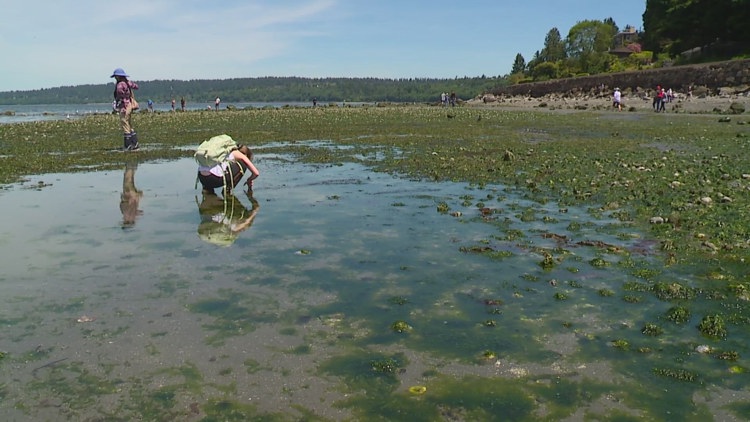
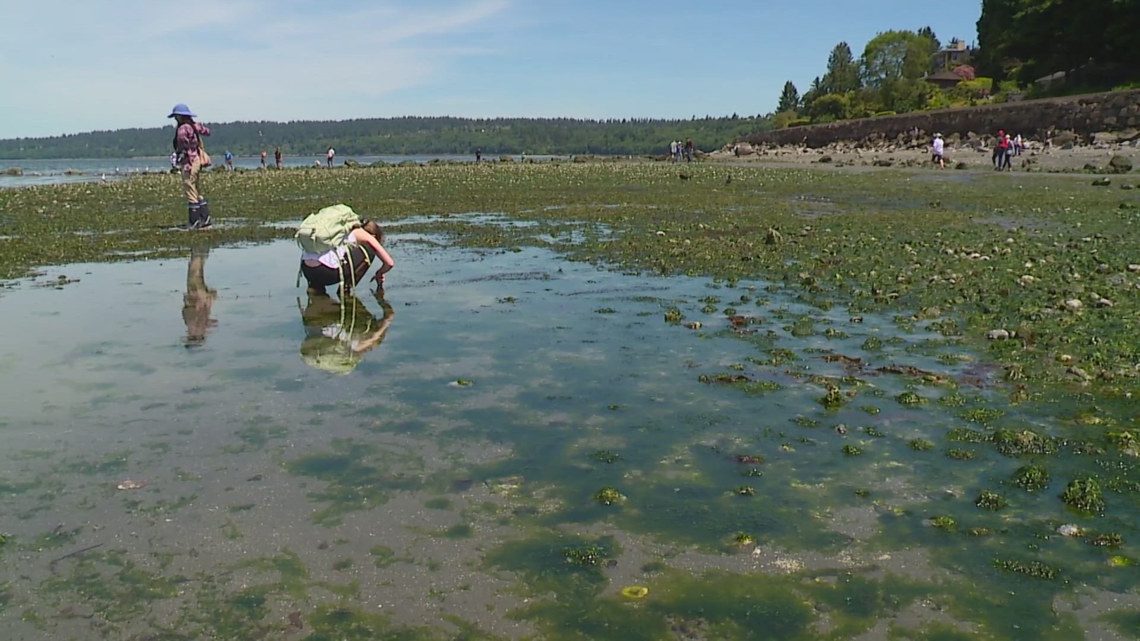
Between Saturday and Wednesday, Puget Sound will see tides dip between -3 and -4 feet, allowing for a rare chance to see marine life up close.

SEATTLE — Western Washington will see low tides in the coming days, allowing residents a chance to see Puget Sound marine life that is often hidden from view.
Tides along coastal areas will dip to -3 to -4 feet below typical levels between Saturday and Wednesday, according to predictions by the National Oceanic and Atmospheric Administration (NOAA).
Tides are expected to reach -3.07 feet around 11 a.m. Saturday, May 16; On Sunday, May 17, tides may hit -3.82 feet around 11:50 a.m. The lowest tide levels will reach is -4.04 feet around 12:30 p.m. Monday, May 18. Tides are predicted to reach -3.73 feet around 1:25 p.m. on Tuesday, May 19. Tides on Wednesday, May 20, are also expected to be at -2.97 feet around 2:20 p.m.
In the Seattle area, the best locations to see marine life on a low-tide beach walk include Alki Beach, Carkeek Park, Lincoln Park and Golden Gardens in Seattle. Other locations include Richmond Beach in Shoreline; Des Moines Beach and Saltwater State Park in Des Moines; Dash Point State Park in Federal Way; and Owen Beach in Tacoma.
What causes low tide?
Tides are the rising and falling of the ocean largely driven by the gravitational pull of the moon and sun and their relative position to Earth. These tides are considered to be very long waves that move across the Earth’s oceans.
When the wave is at its highest point reaching the coast, it’s high tide. When the wave is at its lowest point reaching the coast, it’s low tide.
The lower-than-normal tides unveil areas and ecosystems normally submerged by the cold, salty Puget Sound waters, providing a unique opportunity for people to check out the tidepools and marine life.
Tide pool etiquette
Seattle Aquarium’s Beach Naturalist Program has local experts at various locations to answer questions and help people safely explore marine habitats at low tide – with several opportunities available across Puget Sound this weekend.
To keep yourself and life on the beaches safe, local experts suggest:
- Walk carefully; there is life beneath your feet.
- Touch marine life gently with one wet finger.
- Observe animals where they are and avoid picking them up.
- Only move rocks that are small enough to be moved with one hand. Carefully return the rocks to the exact position you found them in.
- Do not remove anything natural from the beach. Many of the beaches here are protected by law.
- Carry a small garbage bag to pick up trash.

To ensure diverse coverage and expert insight across a wide range of topics, our publication features contributions from multiple staff writers with varied areas of expertise.
