
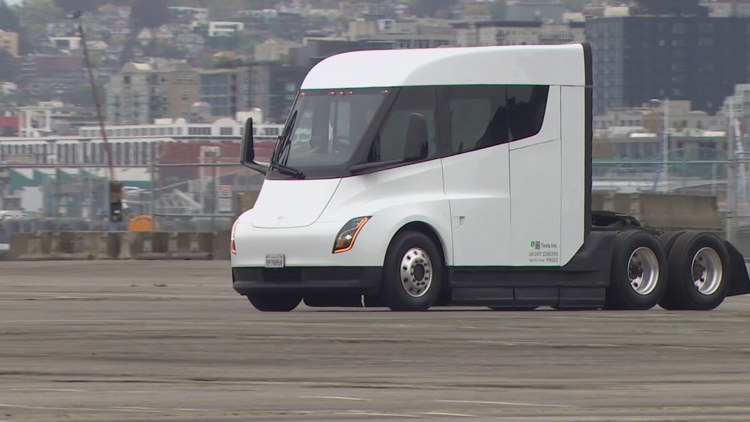
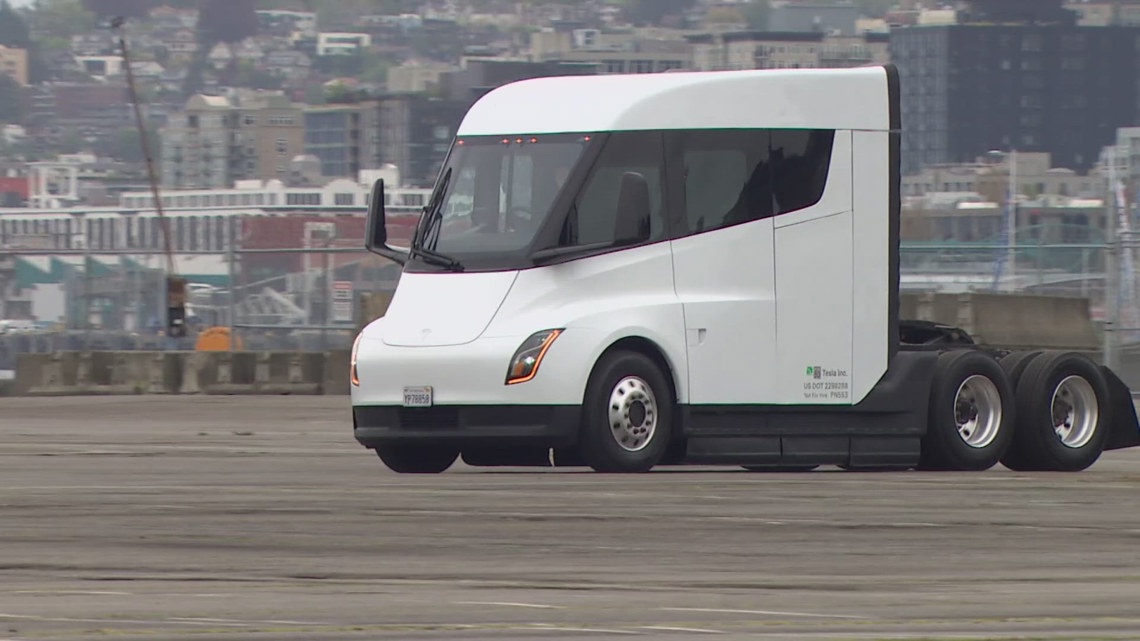
A new program is aimed at helping businesses make the switch to electric vehicles, offering steep discounts on trucks, vans and other commercial equipment.

SEATTLE — Washington state is rolling out a $112 million program aimed at helping businesses make the switch to electric vehicles, offering steep discounts on trucks, vans and other commercial equipment as officials try to accelerate the transition away from fossil fuels.
The Washington Zero-Emission Incentive Program, or WAZIP, opens to applicants Wednesday at 10 a.m., with state leaders expecting strong demand in its first round of funding.
Under the program, companies, nonprofits and public agencies can receive up to 40% off the cost of qualifying zero-emission vehicles and equipment, including freight trucks, delivery vans, construction machinery and some maritime uses.
Gov. Bob Ferguson announced the initiative Tuesday in Seattle, where a lineup of electric vehicles — from box trucks to semi-trucks — was on display at Pier 46.
“We’re investing $112 million to make the purchase of cleaner commercial vehicles and equipment more affordable for a wide range of companies, big and small all across Washington state,” Ferguson said.
The effort is designed to address one of the biggest hurdles facing businesses interested in electrifying their fleets: the upfront cost.
While electric vehicles can offer lower fuel and maintenance costs over time, the initial price tag — along with concerns about how far vehicles can travel on a single charge — has historically slowed adoption. State officials say both challenges are beginning to ease, thanks to advances in battery technology and targeted incentives like WAZIP.
For business owners like John Stromberg, those costs remain a daily reality.
Stromberg runs Happy Hauler, a delivery business, along with a nonprofit arm that furnishes homes for people leaving shelters. He says rising diesel prices, sometimes reaching $7 per gallon, have cut deeply into his operating budget.
“We helped furnish about 600 people last year without any grants or anything,” Stromberg said. “I could go over 1,000 or more if I had electric vehicles, because I’m spending $7 a gallon on diesel, and it’s a huge part of my expenses running so many miles.”
Stromberg said earlier concerns about electric vehicle range are starting to fade as technology improves.
“These iron phosphate batteries are getting better and better, and now the range can take care of us all day for what we need to do,” he said.
State leaders say the program is part of a broader push to cut greenhouse gas emissions while helping businesses reduce long-term operating costs.
It also comes as Washington continues investing heavily in electrifying its ferry system, a transition that has drawn scrutiny over costs and delays.
Converting a single Washington State Ferry to hybrid-electric power has cost about $133 million, roughly $36 million more than originally planned. Ferguson acknowledged there is still work to do but said progress is being made.
“In my 15 months as governor, we’ve really turned that around in large part,” Ferguson said. “The number of sailings that have been canceled has gone down, but we still have more work to do. On our new ferries, yes, we’re moving to electric, but we need to make sure we’re reforming that system.”
For Stromberg and other small business owners, the question now is whether programs like WAZIP will make electric vehicles financially viable in the near term.
“We’ll see if it’s a reality or if it’s a dream,” he said. “I’m still hoping it’s a reality.”
State officials say applications will be processed on a rolling basis, and they encourage businesses to apply early as funding may be limited in initial rounds.

To ensure diverse coverage and expert insight across a wide range of topics, our publication features contributions from multiple staff writers with varied areas of expertise.
