
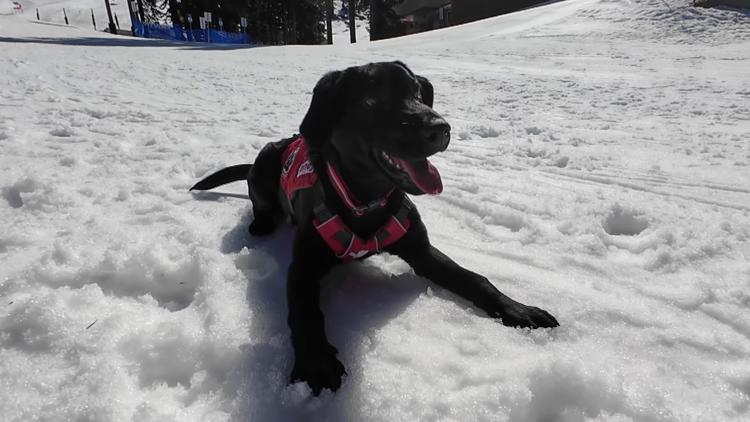
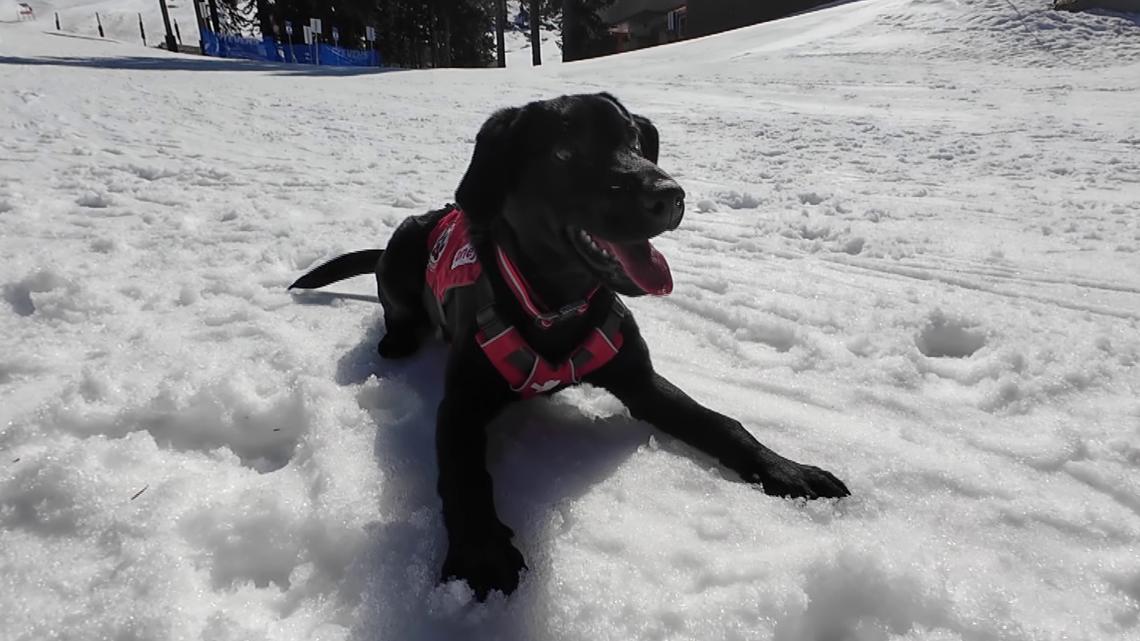
At Stevens Pass, avalanche rescue begins long before a disaster — with puppies learning to play a game that could one day save a life.

SKYKOMISH, Wash. — As the Stevens Pass ski season comes to a close, with less than a week left, the mountain is still buzzing.
Ski lifts hum overhead. Edges carve into packed snow. In the learning area, beginners practice their first turns, falling, getting back up, trying again. A quiet reminder that everyone on the mountain starts somewhere.
Nearby, a handler calls out.
“Honey this way! This way! Yes!” she says, pulling a young dog toward her. “Yes good girl that’s a good girl.”
The dog responds instantly, cutting across the snow, focused on a single voice.
These are avalanche dogs in training. Some not even a year old, are already preparing for a job where hesitation can cost someone everything.
Where it starts
At this stage, the work looks simple.
“Okay so right now we’re working on recalls with Honey,” Angela Seidling, the head of Stevens Pass Ski Patrol, explained. “We like to do recalls with somebody holding the dog and letting the dog go so that we’re not calling our dogs out of a stay command.”
Handlers release the dogs, call them back, and reward them when they return.
“And eventually when Honey starts her search work this will be how she starts for search work too by her handler holding onto her harness.”
Over time, those repetitions build something deeper.
“We’re connected,” Mike, Honey’s handler says, as the dog snaps back into position.
“The bonding has worked,” Seidling said. “The most important thing our puppies do is bond with their handlers.”
That bond becomes the foundation for everything that follows.
It’s all a game
To the dogs, the training feels like play.
“That bond translates a lot to the search work itself because when we teach the search work, it’s all basically a game of hide and seek.”
At first, the exercise is straightforward.
“So it starts with just an open hole and their person teases them and runs away and hides in the hole and someone else is holding their harness gives them the search command and lets them go.”
The dogs respond the only way they know how.
“They run after their handler and get in the hole and get rewarded in that hole.”
But the game doesn’t stay that simple.
Learning to dig — and not stop
As training progresses, the challenge becomes physical.
“The next step is that we actually put blocks of snow in front of that hole so they have to dig in order to get into the snow cave,” Seidling said.
The goal is persistence.
“That phase of training we spend a lot of time in that phase because we want to really train the dogs to dig and not give up,” she said.
At first, that persistence is tied to something familiar.
“The person they’re going to dig and not give up for is their own person, it’s the human they’ve bonded with their whole life until that point.”
But eventually, that changes too.
Finding anyone
“Once we’re really satisfied that they have a strong and consistent dig and they enjoy playing the game, we transition to adding another person to the snow cave and that extra person is going to be doing the rewarding and their person is in there as like a security blanket.”
That transition is essential.
“It teaches them they can play this game with someone else in the snow cave and getting rewarded by another person,” Seidling said.
Because in a real avalanche, the person buried beneath the snow will almost always be a stranger.
When training becomes real
By the time a dog reaches full certification — a process that takes at least three full seasons — the exercise no longer requires setup or cues.
“After that there’s no more teasing and running away, our certified dogs are to the point where you can just bring them to a work site, get ready, tell them to search and they are just going to start searching for human scent in that area.”
On the mountain, that looks different.
Before a drill, handlers check conditions.
“We want to check the wind direction,” Seidling said, before she let Zoey search the work site.
Then the dog is released.
Within seconds, the shift is clear. What once looked like play becomes focused, fast, and precise. Zoey is able to find someone buried under the snow on the work site within seconds.
“You’re such a good dog oh my gosh you found her so fast! You were so good so fast,” Seidling said, rewarding the pup.
Life on the mountain
Avalanche dogs don’t train in isolation. They work in the same environment as skiers — riding lifts, navigating terrain, and staying focused through noise and distraction.
“Okay load up!” Seidling calls, as Zoey climbs onto a chairlift.
The routine is constant.
“After we do a drill, she gets to play with her toy which often times she’ll have, she knows we normally play down there, but she’ll happily come back,” she said.
Because even at the highest level, the work still feels like a game.
When it matters
On a mountain like this, conditions can change quickly. Avalanches can happen without warning.
When they do, time is limited.
The same dogs that once ran back and forth learning to follow their handler are now capable of scanning a debris field in seconds — locating a buried person far faster than a human search team alone.
And somewhere beneath the snow, someone is waiting to be found.
These dogs are trained to get there first.
If you’d like to support the Stevens Pass Avalanche Dog Program, you can by purchasing a t-shirt at ski patrol at Stevens Pass.

To ensure diverse coverage and expert insight across a wide range of topics, our publication features contributions from multiple staff writers with varied areas of expertise.
