
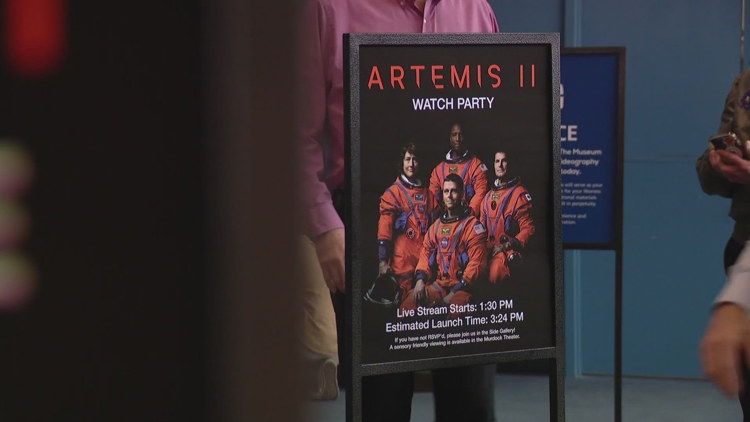
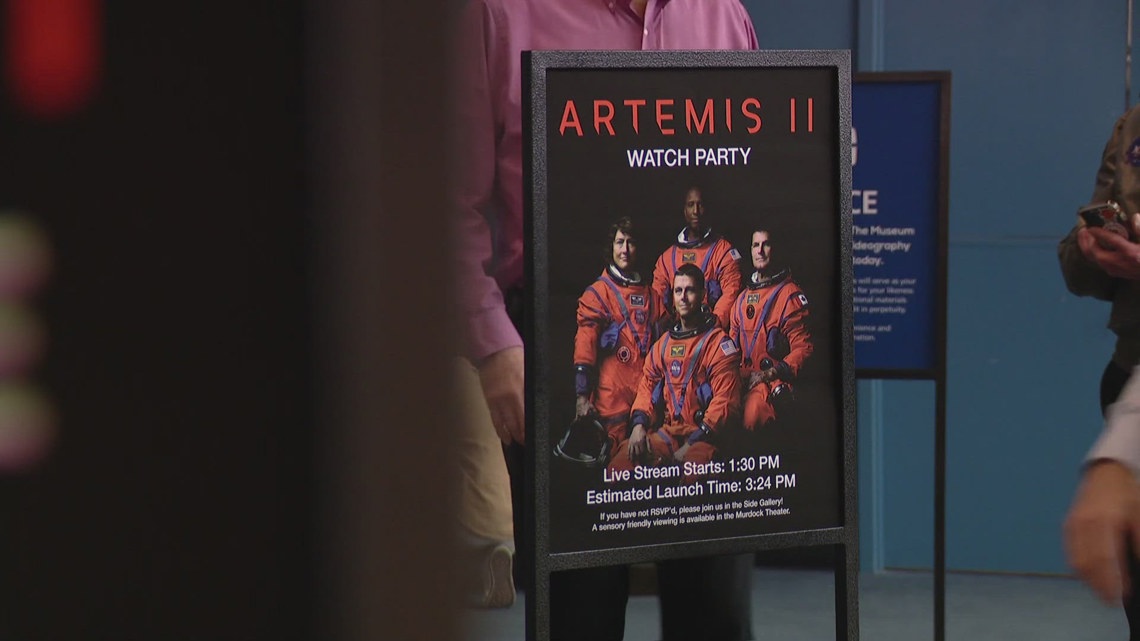
The launch of NASA’s Artemis II, its first crewed lunar mission in over 50 years, captivated Seattle’s Museum of Flight, highlighting aerospace ties.

TUKWILA, Wash. — Students filed into the Museum of Flight on Wednesday afternoon, some pulled out of class early, their eyes fixed on a giant screen broadcasting a moment decades in the making.
NASA’s Artemis II launch — the first crewed mission to travel around the Moon in more than 50 years — drew a packed crowd to the museum, one of just a handful of official watch party sites featured in the agency’s live coverage.
For many in attendance, the launch marked a rare opportunity to witness history unfold in real time.
The Artemis II mission represents a major milestone for NASA as it works to return astronauts to the lunar surface and eventually send humans to Mars. The four-person crew is expected to spend about 10 days traveling around the Moon and back to Earth, venturing farther into space than any human mission since the Apollo era.
The event in Seattle highlighted the region’s deep ties to the aerospace industry, particularly the role of Boeing, which helped build and integrate the core stage of NASA’s Space Launch System.
That connection wasn’t lost on the crowd, which included current and retired Boeing employees alongside families and students experiencing a launch like this for the first time.
Among those watching was Chris Sembroski, a Washington resident and former astronaut who flew as a mission specialist on the Inspiration4, the first all-civilian orbital spaceflight.
Sembroski said missions like Artemis II capture both the imagination and the ambition behind space exploration.
“My mission to space was three days long, and it was just short enough to want several more days in space,” he said. “A 10-day mission for this crew — it’s going to feel like nothing.”
He added that exploration beyond Earth has always been tied to solving challenges back home.
“Space is that great final frontier,” Sembroski said. “We go to space to solve problems here on Earth, and by going and exploring the Moon, it is our next step to go to Mars and beyond.”
At the museum, that sense of possibility was especially visible among younger viewers, many of whom were seeing a major space launch for the first time.
Parents pointed out parallels to the last time humans traveled to the Moon in 1972, when Apollo 17 closed out NASA’s original lunar program. For some in the crowd, that era was a distant childhood memory. For others, it’s something they’ve only learned about in school.
Now, they were watching a new chapter begin.
Organizers said the event was designed not just to celebrate the launch, but to inspire the next generation of scientists, engineers and astronauts.
If all goes as planned, Artemis II will pave the way for future missions that could land humans on the Moon again for the first time in more than half a century — and eventually carry them even farther.

To ensure diverse coverage and expert insight across a wide range of topics, our publication features contributions from multiple staff writers with varied areas of expertise.
