
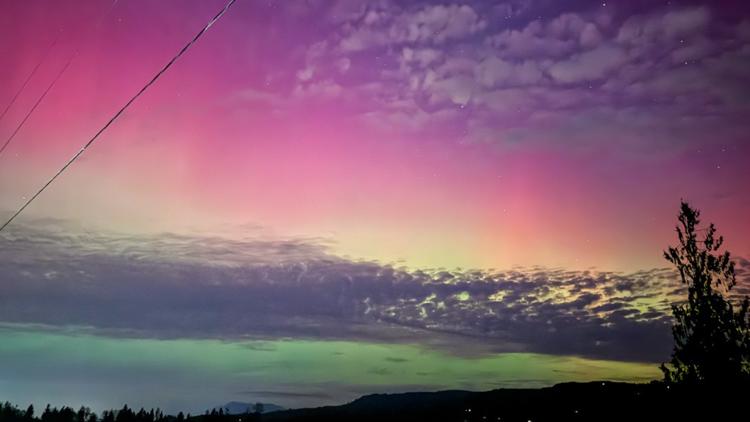
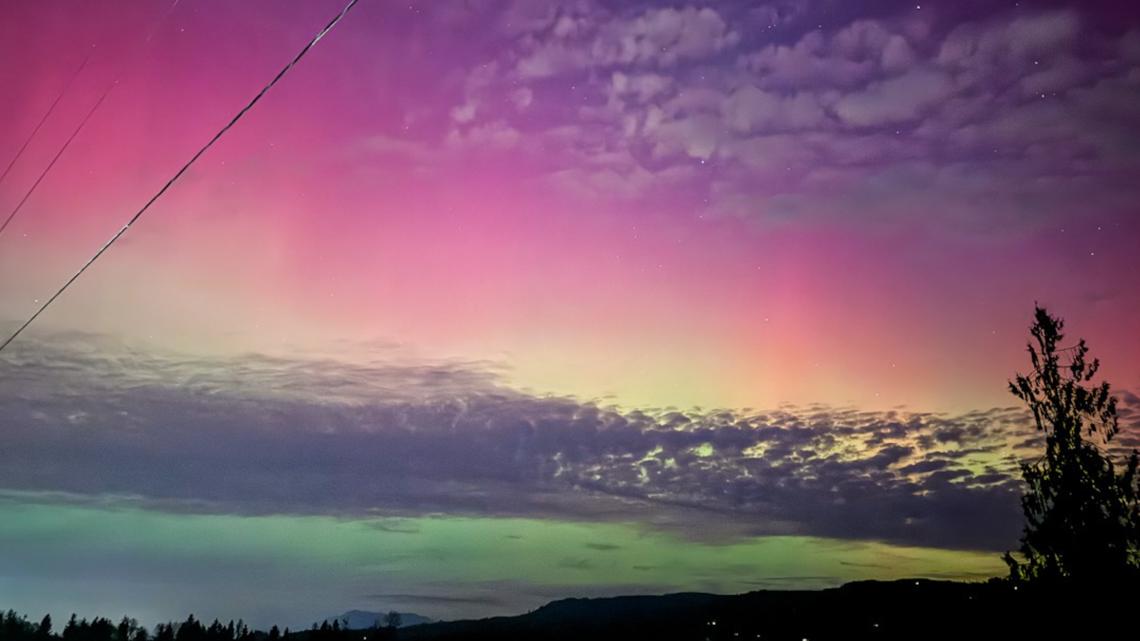
Northern lights may dazzle Washington skies Monday, due to a severe geomagnetic storm alert. Here’s what to know.

SEATTLE — The northern lights may be visible Monday in Washington state, so long as skies stay clear of clouds.
According to the National Oceanic and Atmospheric Administration’s Space Weather Prediction Center forecast for Monday, Jan. 19, the aurora may become visible as far south as Missouri.
The “Kp,” which is the scale NOAA uses to measure the maximum forecasted geomagnetic activity, is an eight on a scale from zero to nine for Monday night’s aurora forecast, as of Monday afternoon. It will drop to a four Tuesday night, according to the forecast.
A severe G-4 geomagnetic storm watch has been issued for Monday night and early Tuesday.
Back in November, the northern lights put on colorful displays across the U.S., including here in Washington state, following a severe G4 geomagnetic storm watch. G4-level watches are rare, with only four alerts issued so far this solar cycle, NOAA previously said.
Viewing the northern lights in Washington state
With widespread aurora displays possible Monday night, there is a high chance it will be visible overhead in Washington. Should it occur, clouds may limit some viewing, but the thicker clouds may not even develop until overnight.
If the aurora develops, the best chance to see it is expected to be earlier in the evening, based on the current forecast, rather than later in the night.
Tips for best aurora borealis viewing
- Move away from city light to a quiet, dark area
- Get a clear view of the Northern horizon
- Get comfortable! It takes your eyes about 15 minutes to acclimate
- Taking a picture with a smartphone may reveal colors that aren’t visible to the naked eye
Northern lights forecasts can be found on NOAA’s Space Weather Prediction Center website or an aurora forecasting app.
What causes the northern lights?
In layman’s terms, the sun is constantly shooting out charged particles. But sometimes, it emits a particularly violent stream of energy known as solar wind, during solar flares or “coronal mass ejections.”
When these energetic solar winds hit the Earth’s atmosphere, they collide with the gases in the upper atmosphere and charge them. As that energy dissipates, it lets out light that we can see.
The different gases produce different colors, which is why an aurora borealis can shift from green and blue to red and purple.

To ensure diverse coverage and expert insight across a wide range of topics, our publication features contributions from multiple staff writers with varied areas of expertise.
