

Groundbreaking research at Seattle Children’s Hospital provides critical genetic diagnoses for newborns within 48 hours.

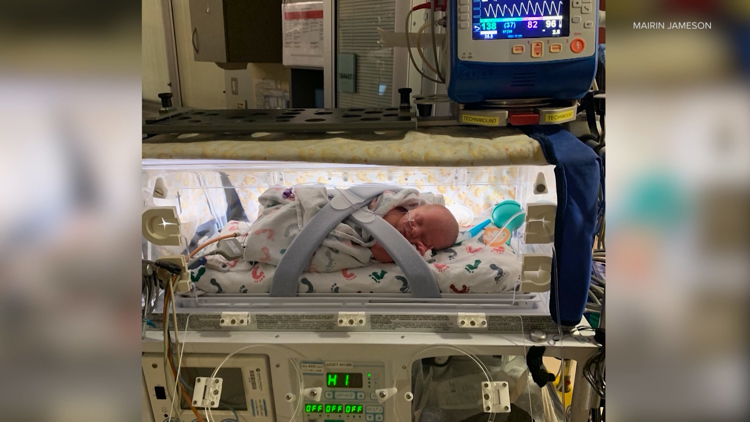
SEATTLE — When Cayden Chambers was born seven weeks premature in July of 2022, his parents, Mairin Jameson and Trystan Chambers, expected minor challenges related to his early arrival and kidney issues. What they didn’t anticipate was learning their son had a rare genetic condition before he was two weeks old.
That swift diagnosis came through SeqFirst, a first-of-its-kind study at Seattle Children’s Hospital that is revolutionizing genetic testing for NICU newborns. The research has tested 4,000 babies in the NICU and found that about one in three have an underlying genetic condition.
“We really just thought he was premature and he was going to have the kidney obstacles, but didn’t suspect anything else,” Jameson said.
The study, conducted in partnership with the University of Washington and GeneDx, takes a dramatically different approach from traditional genetic testing protocols. Rather than waiting for specific symptoms to order testing, doctors offer rapid whole genome sequencing to nearly all NICU babies whose medical issues cannot be fully explained by prematurity, birth trauma or infection.
Dr. Michael Bamshad, head of genetic medicine at the University of Washington and Seattle Children’s Hospital, said the broad testing criteria dramatically improve access to genetic diagnoses.
“We know their prior risk for having a condition just by being admitted to the NICU is high, so let’s virtually test everybody unless we’re confident their clinical findings can be explained by something else,” Bamshad said. “When we did that, we dramatically improved access to a genetic diagnosis.”
The research demonstrates that 42% of diagnosed infants would have been missed using conventional NICU protocols, with 69% of those being non-white, highlighting significant gaps in current diagnostic approaches.
Nearly half — 49.2% — of infants who received rapid genome sequencing obtained a precise genetic diagnosis, compared to just 9.7% who followed conventional diagnostic protocols. The results typically come back within 48 hours to a few days, a stark contrast to the typical timeline.
“It takes five-plus years to get a diagnosis” through traditional methods, said Dr. Britt Johnson, senior vice president of medical affairs at GeneDx.
Cayden was diagnosed with cardiofaciocutaneous syndrome — a genetic condition affecting the heart, skin and face. The early diagnosis allowed his parents to immediately begin assembling a care team.
“They give out a handout, and it was front and back of all the things that can go wrong,” Jameson recalled. “We got transferred and referred to neurology, cardiology, ophthalmology, audiology, right off the bat. All these people were coming into his room at the NICU to test his baseline.”
The immediate information allowed the family to prepare during Jameson’s maternity leave, rather than scrambling to arrange specialist appointments while working full-time after Cayden turned one or two.
“I was on maternity leave, so I was able to do, when we got out of the NICU, all of his appointments and specialists during that time off,” Jameson said. “In hindsight, I’m so thankful for the early testing.”
Now 2 years and 5 months old, Cayden is learning to scoot and uses a wheelchair for mobility. He receives food through a tube and is working on speaking. His parents have equipped their home with devices to help with his developmental delays — all because they knew from day one what challenges to expect.
“Early intervention really matters,” Dad Trystan Chambers said. “Getting that information as early as possible has allowed us to pursue avenues to find abilities for him to do normal things or start practicing normal things. So it’s set us ahead in a lot of ways.”
The SeqFirst study specifically aimed to address inequities in genetic testing access.
Research published in the American Journal of Human Genetics found that at least 60% of Level IV NICU infants should be receiving rapid genome sequencing.
With approximately 400,000 newborn admissions across 800 U.S. NICUs annually, tens of thousands of infants with genetic conditions are likely being undiagnosed due to a lack of access to testing.
Johnson noted that 90% of genetic conditions diagnosed through this rapid testing were not clinically suspected based on physical features alone.
“Instead of having very complicated criteria to say ‘Hey, this is when a baby should get rapid genome sequencing,’ the study just says ‘Hey, if a baby did not have symptoms that are fully explained by some sort of birth trauma or infection or prematurity, but are in the NICU so there’s a problem, they should be getting rapid genome sequencing,'” Johnson said.
The testing costs a few thousand dollars per infant, which raises questions about universal adoption. However, study leaders point out that each day in the NICU can cost $10,000, and early diagnoses can reduce hospital stays by 14 to 21 days while eliminating unnecessary procedures.
For genetic conditions with available treatments, the timing can be even more critical.
Bamshad noted that for children with treatable metabolic disorders, a precise genetic diagnosis days after birth could be the difference between healthy development and irreversible damage or death.
The study team hopes to expand the program so all NICU babies — and eventually all newborns — have access to early genetic testing. Researchers are now examining whether the approach works in NICUs at different care levels beyond the Level IV unit at Seattle Children’s, where the most critically ill babies are treated.
For the Jameson-Chambers family, watching Cayden master new skills like scooting across the floor represents victories that might have been delayed without early intervention.
“Milestones mean so much more to us because they took so long to come,” Jameson said. “You have taught your mom and dad a lot in your short little life,” she told Cayden.

To ensure diverse coverage and expert insight across a wide range of topics, our publication features contributions from multiple staff writers with varied areas of expertise.
